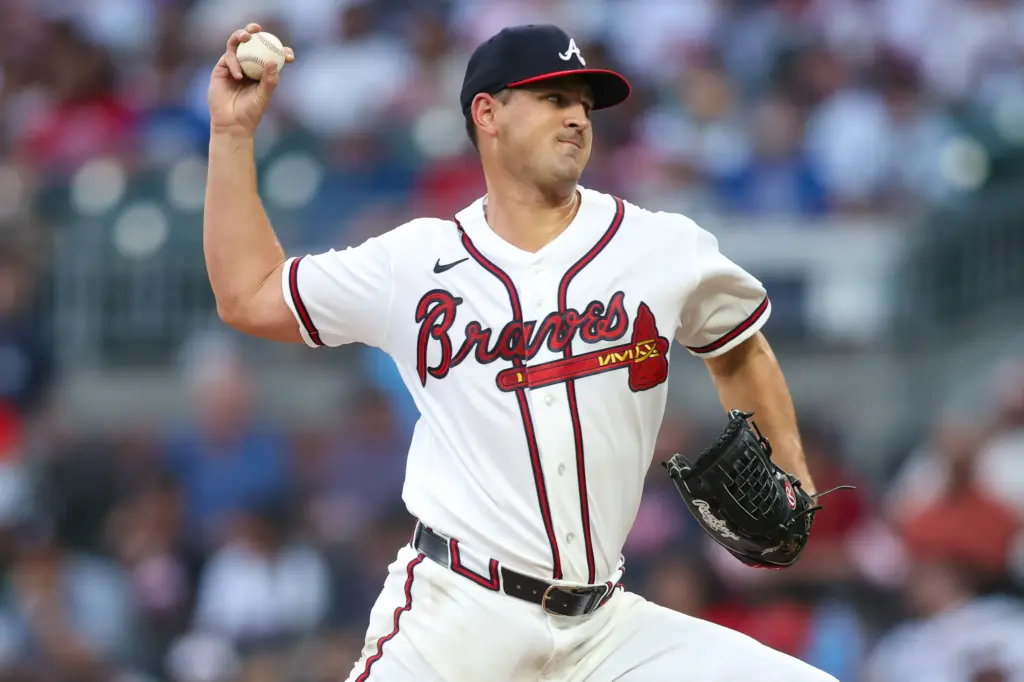
The Tyler Mahle acquisition that sent the right-handed starter to the Atlanta Braves was viewed as a low-risk move for the NL East leaders, but with it came criticism from fans and analysts alike. While other teams went out and acquired big names, this was the biggest move the Braves made as far as starting pitching goes and it left fans with a “that’s it?” type of reaction. Atlanta entered the 2026 trade deadline with a glaring problem: an injury-depleted starting rotation. With impact arms like Reynaldo Lopez hitting the injured list right before the deadline, alongside existing structural challenges in the rotation, president of baseball operations Alex Anthopoulos had to pivot quickly.
While a large portion of the fanbase clamored for blockbuster names like Tarik Skubal or Logan Webb, Atlanta instead acquired Mahle from the San Francisco Giants in exchange for minor league reliever Anthony Molina.
On the surface, a look at Mahle’s 5.13 ERA over 18 starts with the Giants left many questioning the move. However, initial analytical deep-dives suggested otherwise, and his early performances in an Atlanta uniform have proven that the Mahle acquisition was a masterstroke of low-risk, high-reward roster building.
Tyler Mahle Acquisition Looks Great Early On
The Deceptive Stat Line: Digging Past the Surface ERA
The principal reason the market undervalued Mahle was a bloated ERA inflated by a rough stretch early in the season and a brief stint on the injured list with a left hamstring strain. Savvy front offices look past surface-level metrics to underlying indicators, which is why Atlanta chose to pursue the Mahle deal.
Mahle’s 4.38 Fielding Independent Pitching (FIP) with San Francisco strongly signaled that bad luck, defensive sequencing, or the environment of Oracle Park skewed his traditional run-average metrics upward. After returning from his previously mentioned hamstring injury, Mahle silently began turning things around. In his final nine starts before being dealt, he recorded a much more palatable 3.06 ERA.
Atlanta recognized that they weren’t trading for a broken pitcher. With the Mahle acquisition, they were buying low on an arm experiencing rapid, positive regression.
Immediate Impact: Dominant Performances Against the New York Franchises
If there were lingering doubts about how Mahle would handle the pressure of joining a contender, he erased them immediately upon arrival.
On August 7, Mahle made a brilliant team debut in the Bronx against the New York Yankees, firing six scoreless frames and racking up nine strikeouts. He followed that performance on August 12 by stifling the rival New York Mets at Truist Park, surrendering only a solo home run while striking out seven over six strong innings to earn the victory.
Allowing just one earned run over his first 12 innings while flashing 16 strikeouts represents true frontline results for a pitcher acquired as “depth.” The early returns on the Mahle acquisition have already started to silence the critics.
Tweak and Track: The Atlanta Pitching Infrastructure
The Braves have built a well-earned reputation for maximizing veteran pitching talent. Early tracking data indicates that Atlanta’s coaching staff has already begun optimizing Mahle’s pitching sequences.
Mahle’s velocity is up nearly a full mile per hour relative to his previous seasons, touching 95 mph with late life while also mixing in a devastating splitter. By leaning heavily into his high-spin four-seam fastball, vertical splitter, and mixing in a crisp cutter, he has quickly transformed from a back-of-the-rotation innings eater into a viable postseason weapon.
The Verdict
Anthopoulos managed to solve the club’s desperate need for starting distance without surrendering a single high-tier prospect from the farm system. By trading Molina, a low-leverage reliever with a 5.40 ERA in the big leagues, the Braves effectively mitigated all mechanical and financial risks in the Mahle deal.
With the Braves boasting a comfortable multi-game cushion in the NL East, Mahle’s presence provides structural flexibility. He helps give frontline starter Chris Sale crucial extra days of rest, bridges the gap until Lopez returns, and forces his way into the conversation to start Game 2 or Game 3 of a playoff series.
It’s unlikely that we will continue to see Cy Young type of performances out of Mahle for the remainder of the season, but if Atlanta can get the pitcher that has been hovering around a 3.00 ERA over his last 10 or 11 starts, that is a huge win for the team. Ultimately, the Mahle acquisition fits the classic Atlanta acquisition blueprint perfectly: low cost, elite underlying pitch analytics, and immediate, high-stakes dividend output.
Main Image: Brett Davis-Imagn Images