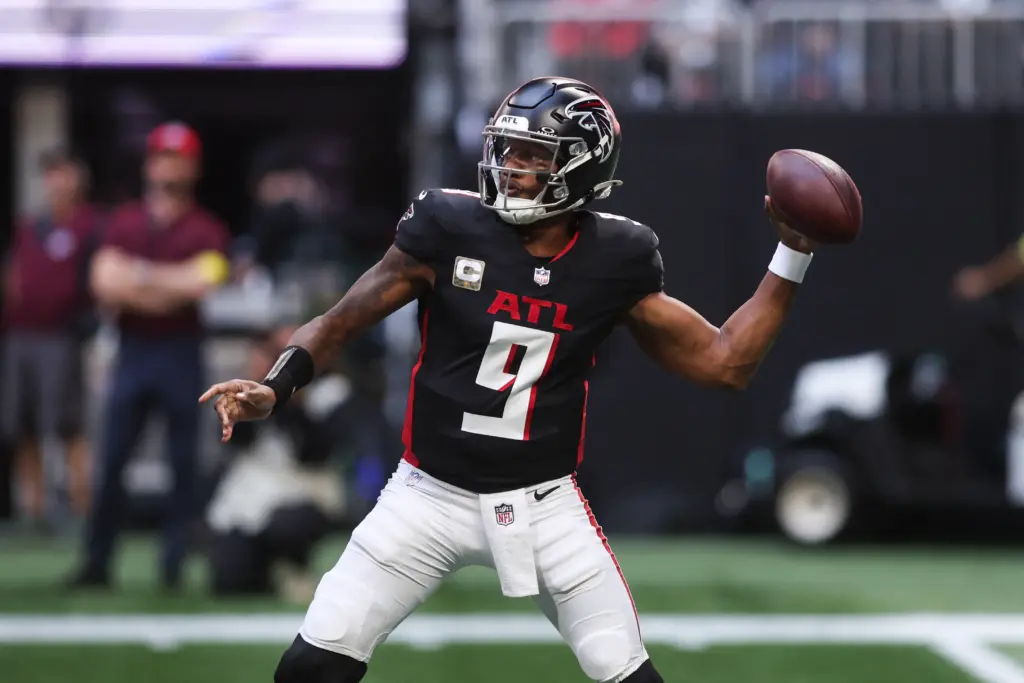
Ahead of the 2026 NFL season, Tua Tagovailoa is the favorite to start at quarterback for the Atlanta Falcons, while third-year quarterback Michael Penix Jr. continues recovering from a torn ACL.
Penix, the No. 8 overall pick in the 2024 NFL Draft, was selected by Atlanta’s previous regime. This offseason, the Falcons overhauled their front office, replacing general manager Terry Fontenot, head coach Raheem Morris and offensive coordinator Zac Robinson with President of Football Matt Ryan, general manager Ian Cunningham, head coach Kevin Stefanski and offensive coordinator Tommy Rees.
During Penix’s recovery process, Atlanta brought in Tagovailoa after his release from the Miami Dolphins. With the Dolphins already paying him nearly $53 million this season, Tagovailoa signed a veteran-minimum deal with the Falcons.
Penix has been rehabbing since November 2025, and the arrival of Tagovailoa has fueled speculation that his future in Atlanta is fading. His extensive injury history certainly gives the Falcons reason for concern. Yet, when judged strictly by his performance on the field, Penix may be one of the NFL’s most overlooked quarterbacks.
To understand why, let’s break down Penix Jr.’s professional career thus far.
Penix Jr. Career Breakdown in Atlanta
The “Rookie Campaign”
Saying the Falcons drafting Penix in 2024 was a shock is the understatement of the year. It wasn’t just a shock to the media, but it also shocked newly signed veteran quarterback Kirk Cousins. Cousins signed a four-year $180 million deal a month before draft night—only for Atlanta to select Penix No. 8 overall.
The original plan was for Penix to sit behind Cousins for a few seasons to develop under him. Plans changed ahead of Week 16 of the 2024 NFL season when Penix was announced the starter for the Falcons upcoming matchup vs. the New York Giants.
Game 1: Atlanta Falcons vs. New York Giants | Year 1, Week 16 | 34-7 W
Penix had a favorable matchup to start his career. The Giants defense ranked 24th in total defense and 21st in scoring defense in 2024. Penix went 18-of-27 for 202 yards and an interception. This stat line isn’t going to blow your mind, but it doesn’t tell the full story.
He operated the offense very well in his inaugural start with poise and comfort in the pocket. Mistakes from his pass catchers led to easy drops and an interception that should’ve been Penix’s first passing touchdown of his career.
A simplified offense allowed Penix to build confidence and complement the offense. Throwing with anticipation, reading the middle of the field, operating inside the pocket, showcasing his arm talent and limiting mistakes highlighted the day.
Game 2: Atlanta Falcons at Washington Commanders | Year 1, Week 17 | 30-24 (OT) L
Penix’s next opponent was a bit tougher as the Commanders ranked 13th in total defense, third against the pass and 18th in scoring. Penix struggled at times in this game going 19-of-35 for 223 yards, a touchdown and an interception. The interception came early in this game due to miscommunication on a route.
It was looking like a rough second game for Penix, but he figured it out in the fourth quarter. Converting a fourth-and-11 late in the game to Drake London to keep the game alive and an impressive touchdown pass to Pitts on fourth-and-goal from the 13-yard line. Penix read the field, stayed calm in the pocket and fired a high-velocity, tight-window throw to even up the game late in the fourth quarter.
The Falcons got the ball back with 40 seconds on the game clock and Penix threw a dot on the sideline to Darnell Mooney for a chunk gain, along with a pass interference later, to set the Falcons up for a game-winning field goal try. Riley Patterson missed the kick and the Commanders would end the game on the first drive of overtime.
The Falcons have to be satisfied with this outing from Penix. He starts the game on a bad note and ends it very strong with game-extending conversions, an impressive touchdown pass and the clutch and poise you need at the quarterback position.
Game 3: Atlanta Falcons vs. Carolina Panthers | Year 1, Week 18 | 44-38 (OT) L
The 2024 Carolina Panthers ranked 32nd in total defense, 23rd against the pass and 32nd in scoring. Clearly a bad unit and that continued in Week 18. Penix capped off his rookie season going 21-of-38 for 312 yards, three total touchdowns and an interception.
Film study on Penix was very impressive in this game. His skill throwing outside the hashes at the college level has clearly translated in the NFL. The ability to push the ball downfield, willingness to hang in the pocket and fire when the hit is coming, flashes of play-extension and throws on the move were on display.
Furthermore, Week 18 was the beginning of his connection with London. London had 10 receptions for 187 yards and 2 touchdowns. Penix led two 11-play touchdown drives in the fourth quarter in response to Carolina. One of those drives to tie the game with under a minute remaining. Like the Commanders, the Panthers would end the game on the first drive of overtime.
Notice the quotations on The “Rookie Campaign” heading. Penix’s rookie season was just three starts. The Falcons had seen enough this season to be confident that Penix was their guy going forward. So much so that Atlanta traded its 2026 first-round pick to move back into the first round of the 2025 NFL Draft and select James Pearce Jr.—a move that reflected the organization’s confidence in a successful 2026 season with Penix leading the Falcons.
Penix had a big-time throw percentage of 9%. That ranked inside the top-5 of quarterbacks with at least 100 dropbacks. Penix went 1-2 in his first three starts and in two of those games his offense never got to touch the ball in overtime. 2024 was a small sample size, but Penix gave the Falcons a chance to make the playoffs when all hope was lost and gave a franchise that had been a revolving door at quarterback reason to believe he could be their future.
Penix’s “True” Rookie Season
Penix entered the 2025 season with expectations already mounting. Atlanta had watched a promising 6-3 start unravel into a disappointing 8-9 finish the year before, putting pressure on the previous regime to turn things around quickly. Fontenot responded aggressively, parting with significant draft capital to bolster the defense and placing a sizable bet on Penix’s ability to lead the Falcons back into playoff contention.
Game 4: Atlanta Falcons vs. Tampa Bay Buccaneers | Year 2, Week 1 | 23-20 L
The Falcons opened the season against the defending NFC South Champion Tampa Bay Buccaneers, a defense that ranked 19th in total defense, 27th against the pass and 20th in scoring. Penix came out firing, completing 27-of-42 passes for 298 yards and two total touchdowns.
The opener provided an early look at how Atlanta planned to attack through the air in 2025: finding holes in zone coverage, throwing with anticipation and emphasizing the outside of the field. Penix consistently trusted his pass catchers to be in the right spot, often releasing the ball before they came out of their breaks. That anticipation has quickly become a defining trait of his passing game.
Once again, Penix elevated his play when the game mattered most. Trailing late in the fourth quarter, he marched Atlanta down the field before making a diving effort through contact on fourth-and-goal to give the Falcons the lead.
Tampa Bay answered with a touchdown, leaving Penix less than a minute to get Atlanta into field-goal range. He responded by completing four passes and adding a chunk gain with his legs, setting up Younghoe Koo for a 44-yard attempt to force overtime. Koo pushed the kick wide right as time expired. Despite the loss, Penix delivered a promising performance in just his fourth career start.
His record dropped to 1-3, but the number hardly tells the full story. Two of those losses came in overtime without Penix ever touching the ball, while another ended on a missed, makeable field goal that could have sent the game to overtime.
Through four starts, Penix had consistently given Atlanta a chance to win when it mattered most.
Game 5: Atlanta Falcons at Minnesota Vikings | Year 2, Week 2 | 22-6 W
After a tough loss to a division rival, the Falcons traveled to Minnesota to face one of the NFL’s top defenses. The Vikings ranked third in total defense, second against the pass and seventh in scoring in 2025.
Atlanta leaned heavily on its ground game, with Bijan Robinson and Tyler Allgeier combining for 38 carries and 219 yards. The dominant rushing performance limited Penix’s opportunities through the air, as he finished 13-of-21 for 135 yards. Even on limited attempts, Penix’s arm talent stood out. His quick release and elite velocity allow him to shorten his throwing motion without sacrificing much on the ball, giving him the ability to get passes out quickly when pressured.
The 22-6 final score doesn’t tell the full story. Atlanta reached the red zone five times but came away with just one touchdown, with Vikings pressure and costly penalties repeatedly stalling drives. Those missed opportunities ultimately defined the game.
Penix did what was asked of him. He played within the offense and protected the football by avoiding putting the ball in harm’s way against one of the league’s best defenses.
Game 6: Atlanta Falcons at Carolina Panthers | Year 2, Week 3 | 30-0 L
Penix’s next game stands as the biggest blemish on his young career. Coming off an impressive primetime win over the Vikings, the Falcons were shut out on the road by the division-rival Panthers. Penix finished 18-of-36 and threw two second-half interceptions against a Carolina defense that ranked 16th in total defense, 15th against the pass and 15th in scoring.
Despite the final score, Atlanta moved the ball reasonably well in the first half, reaching scoring position on each of its first two drives. However, special teams issues quickly became a problem, as newly signed kicker John Parker Romo missed multiple field goals.
Poor clock management only made matters worse. Atlanta burned an early timeout before immediately taking a delay-of-game penalty coming out of it—an inexcusable sequence. Later, the Falcons wasted another timeout as the play clock expired, leaving them shorthanded during their two-minute drill. Atlanta still managed to reach Panthers territory, but another promising drive ended without points as time expired.
Things quickly unraveled in the second half. On Atlanta’s opening possession, Penix threw a pick-six after Carolina anticipated a pass to the flat. Cornerback Chau Smith-Wade made an excellent break on the ball and walked into the end zone. Carolina stretched its lead to 27-0 early in the fourth quarter before Penix threw his second interception. Facing fourth down, he forced a pass toward the sticks intended for Ray-Ray McCloud III. McCloud slipped coming out of his break, allowing Mike Jackson to jump the route and put an end to any hope of a comeback.
For the first time in his young career, Penix looked like a quarterback with only six NFL starts under his belt. As Atlanta fell behind, he reverted to what he was most comfortable with, and Carolina was prepared for it. They made Penix operate over the middle of the field and capitalized on forced passes to the outside. Panthers defensive coordinator Ejiro Evero deserves plenty of credit for the second-half adjustment.
Atlanta’s first-half mental errors kept points off the board, while Penix’s second-half turnovers turned a frustrating performance into an ugly one.
Game 7: Atlanta Falcons vs. Washington Commanders | Year 2, Week 4 | 34-27 W
A bounce-back performance was exactly what Atlanta needed against Washington. The Commanders struggled defensively in 2025, ranking 32nd in total defense, 28th against the pass and 27th in scoring. The Falcons took full advantage, exploding for 34 points as Penix finished 20-of-26 for 313 yards, two touchdowns and an interception.
Penix was at his best from the pocket, delivering impressive throws even as pressure closed in. His willingness to stand tall, absorb contact and still deliver an accurate ball showcased a premier quarterback trait. More importantly, Penix returned to what he has done best throughout his young career—manipulating defenses with anticipation and timing while taking what was available. He knew when to check the ball down and when to attack downfield.
His lone major mistake came on an interception near the sideline. Penix underthrew a layered pass and put too much air underneath it, giving the defender time to recover and make a play.
With Atlanta’s double-digit lead cut to seven late, Penix helped ice the game with multiple clutch conversions. He scrambled for a first down on a broken third-down play, then beat the blitz on another third down with a strike to Kyle Pitts downfield. Penix released the ball before Pitts made his break to the outside—anticipation at its finest.
This was exactly the response Atlanta wanted after Penix’s forgettable performance against Carolina. He put the previous game behind him, took advantage of a struggling Washington defense and helped get the Falcons back in the win column.
Game 8: Atlanta Falcons vs. Buffalo Bills | Year 2, Week 6 | 24-14 W
In Week 6, the Falcons made a statement on prime time, dominating the Buffalo Bills behind an impressive first half on both sides of the ball. Atlanta entered halftime with a 21-7 lead after carving up a Buffalo defense that ranked seventh overall, first against the pass and 12th in scoring. Penix finished 20-of-32 for 250 yards and a touchdown.
Atlanta’s stars powered the offense. Robinson exploded for 238 total yards and a touchdown, while London hauled in 10 passes for 158 yards and a score. Against the NFL’s top-ranked pass defense, the connection between Penix and London stood out. Penix plays with tremendous trust in his receivers, often throwing with anticipation and expecting them to recognize the same openings he sees. London consistently rewards that trust. Their chemistry is a major reason Atlanta is so effective against zone coverage, with Penix identifying soft spots and London finding them.
Their touchdown connection was a perfect example. With London in the end zone, Penix placed the ball on his inside shoulder, allowing the bigger receiver to use his frame to shield the defender. The pass arrived as London turned for the ball, giving the defender almost no opportunity to make a play. It was precise timing and placement built around London’s strengths.
Penix and London nearly struck again before halftime. After the Falcons forced a late Josh Allen turnover, Atlanta appeared content to work into field-goal range and extend its lead. Buffalo anticipated another quick completion toward the sideline, but Penix attacked the middle instead, hitting London on a slant with room to run. London raced toward the end zone but barely stepped out while reaching for the pylon as time expired. Atlanta came away without points, but the play was another example of Penix recognizing what the defense expected and attacking elsewhere.
The second half told a different story. With a comfortable lead, Atlanta became more conservative offensively, while Buffalo shifted toward heavier man coverage. Penix struggled to maintain the rhythm he established in the first half, and the passing game stalled. Fortunately, the damage had already been done, and Atlanta controlled the game the rest of the way.
The first half showed how dangerous this offense can be when Penix is in rhythm and distributing the ball to his playmakers. The second half exposed the next step in his development: adjusting quicker when a defense changes its approach.
Through eight career starts, Penix had already shown plenty of reasons for Atlanta to believe in him. The arm talent, anticipation, pocket presence and late-game poise were all there, but so were the inconsistencies expected from a young quarterback still learning how to adjust at the NFL level.
And his biggest tests were still ahead.
In Part 2, we’ll break down the remainder of Penix’s 2025 season, the injury that brought it to an abrupt end and what his limited body of work says about his future with the Falcons.
Main Image: Brett Davis-Imagn Images