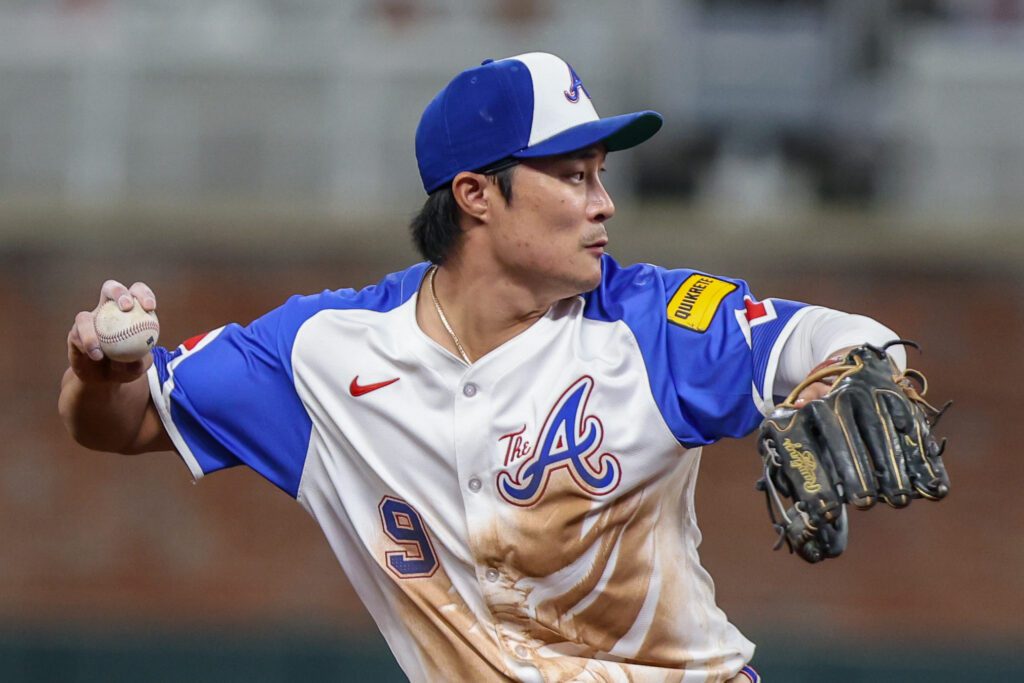
The Atlanta Braves‘ decision to re-sign shortstop Ha-Seong Kim to a one-year, $20 million contract significantly addresses a major offseason priority, solidifying a position that had lacked a consistent everyday presence since Dansby Swanson‘s departure. This move provides the Braves with a reliable, Gold Glove-caliber defender at a premium position and offers the potential for an offensive spark, should he return to his 2023 form. The signing immediately shapes Atlanta’s infield alignment and provides crucial depth, positioning the team for a bounce-back 2026 season.
The Impact Ha-Seong Kim Will Have on the Braves
Solidifying the Middle Infield Defense
Kim’s primary impact is on the defensive stability of the Braves’ infield. His 2023 season with the San Diego Padres showcased elite defensive skills, earning him a Gold Glove Award and the recognition as one of the best defenders in the league. While his 2025 defensive metrics were a slight concern, likely due to a right shoulder injury that delayed his season debut, the Braves are banking on a full recovery and a return to his previous form.
Having Kim as the everyday shortstop allows the Braves to optimize the rest of their roster. It shifts offseason acquisition Mauricio Dubón, a two-time utility Gold Glove winner, into a versatile “super-utility” role, where he is better suited to provide excellent defensive depth across the infield rather than being relied upon as an everyday starter. This defensive alignment makes the Braves stronger up the middle, which is a cornerstone of championship-caliber teams.
Offensive Potential and Lineup Flexibility
Offensively, the signing is a calculated risk with high upside, Kim’s 2025 season saw him slash just .234 across stints with the Tampa Bay Rays and Braves, a down year attributed largely to injury. However, his performance improved significantly after joining Atlanta, where he hit .253 with three home runs in 24 games.
The hope is that a healthy, age-30 season will see Kim replicate his 2023 production, where he hit .260 with 17 home runs and 38 stolen bases. If he can provide even league-average offensive production from the shortstop position, combined with his elite defense, he becomes an incredibly valuable asset. His ability to get on base (evidenced by his strong OBP in 2023) and speed on the basepaths add dynamics the Braves’ lineup sometimes lacked in 2025.
Strategic Roster Construction and Future Implications
General Manager Alex Anthopoulos used the one-year deal to address the immediate need at shortstop without committing to a long-term, high-dollar contract, which was a challenge in a weak free-agent shortstop market. This approach maintains future financial flexibility while addressing the team’s most pressing need.
The short-nature of the contract is a “prove-it” deal for Kim, who declined a $16 million player option to secure a higher $20 million salary for 2026 and re-enter free agency next winter. If Kim has a strong, healthy season, he will be in line for a multi-year contract, potentially with the Braves, as Anthopoulos expressed a desire for a “longer marriage”.
In the broader context of the Braves’ offseason, this move, combined with other recent signings like reliever Robert Suarez and outfielder Mike Yastrzemski, signals an aggressive approach to immediately improve the team following a disappointing 2025 campaign. By locking down the middle infield, the front office can now fully concentrate on acquiring a front-line starting pitcher to fortify the rotation for a 2026 championship push.
Signing Kim is a shrewd, low-risk (in terms of long-term commitment), high-reward move that significantly enhances the Braves’ defensive prowess and provides an offensive wildcard. It brings stability to a key position and allows the team to utilize its depth players more effectively, creating a more balanced and competitive roster for the upcoming season.
Main Image: Jordan Godfree-Imagn Images