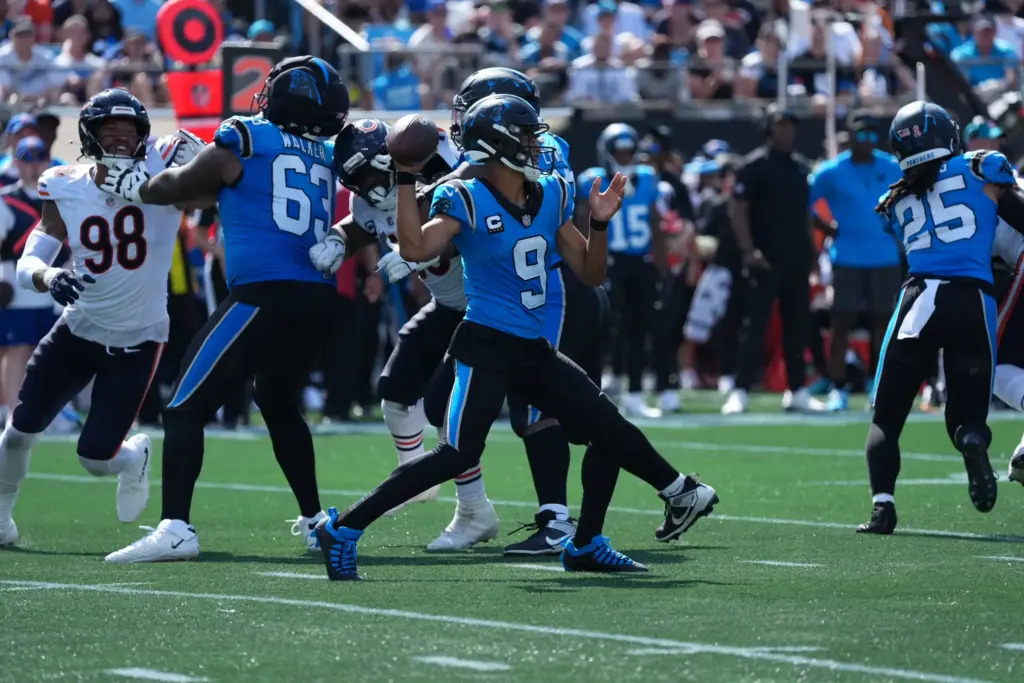
The opening weekend of the 2026 NFL season treated football fans to a historic, albeit bizarre, offensive explosion. The most jarring example occurred at Bank of America Stadium, where the Carolina Panthers fell to the Chicago Bears in a staggering 59-37 shootout. In any normal circumstances, allowing 59 points is an unmitigated disaster that completely deflates the franchise. Yet, amidst the defensive ruins, Bryce Young delivered one of the most dazzling and efficient performances of his professional career.
Young’s opener would result in him completing 23 of 37 passes for 361 yards, three passing touchdowns, one interception, and a rushing score.
For a player looking to earn a contract extension, this massive outburst was exactly what the front office needed to see. However, the 22-point margin of defeat left analysts deeply divided. Was Young’s opener a definitive sign of his true development, or was it merely an anomaly born out of a chaotic game script?
Analyzing Bryce Young’s Opener: A Sign of Things to Come?
The Case for True Development
The most compelling argument that Young’s opener serves as a sign of sustainable growth lies in how he operated within the offense. Under the direction of head coach Dave Canales and new play-caller Brad Idzik, he looked fundamentally different from the hesitant quarterback who has struggled greatly in the past.
In previous season debuts, Young struggled immensely, combining for just 461 yards, two touchdowns, and six interceptions across his first few years. Against Chicago, however, he looked decisive, poised, and strictly in rhythm. He dropped back with balanced footwork and unloaded the football without the agonizing micro-hesitations that previously led to astronomical sack numbers.
Young wasn’t just dinking and dunking to safety valves. He attacked the intermediate and deep parts of the field with precision. His chemistry with emerging wideout Jalen Coker was fully on display. Coker hauled in eight catches for 138 yards and two touchdowns, highlighted by a perfectly placed 51-yard touchdown strike down the sideline. Coker appears to be blossoming into a star, and this will only make life easier for the young quarterback.
The offense also used Tetairoa McMillan and welcomed back running back Jonathon Brooks, connecting with Brooks on an explosive 48-yard play. This wasn’t just an offense relying on luck, it was a structured, vertically capable unit executing a clear game plan. Young is starting to consistently show improved footwork and a willingness to push the ball down the field. Combine this with the offensive talent around him and this is a recipe for long term success.
The Case for an Anomaly
Conversely, skeptics point out that the environment of the game heavily inflated the offensive box score. When a defense yields 59 points, 552 total yards, and six rushing touchdowns, the standard rules of NFL game flow completely go out the window.
Because the Bears scored at will, the Panthers were forced into an ultra-aggressive, high-volume passing script from the second quarter onward. Shootouts naturally elevate quarterback statistics because defensive backs play softer, clock-killing zone coverages. The Bears were content to exchange blows while holding a multi-score lead in the second half, meaning much of the yardage in Young’s opener came against a relaxed defensive shell.
Putting up 37 points is incredibly difficult in the NFL, but doing so while losing by more than three touchdowns indicates an unsustainable style of play. Teams cannot survive in the long term by turning every Sunday into a track meet. If future opponents implement slower, physical defensive schemes that take away the deep boundary throw to Coker, it remains to be seen if he can replicate this level of efficiency.
The Verdict: Growth Wins Out
Labeling Young’s opener as either pure development or a total fluke simplifies a nuanced reality. The truth sits comfortably in the middle, leaning toward genuine structural growth.
While the Panthers will likely not score 37 points every week, the physical mechanics, elite eye level under pressure, and downfield execution displayed in Young’s opener were entirely real. He finished the game with an excellent 110.3 passer rating, becoming only the second quarterback in Panthers history, joining Steve Beuerlein in 1999, to throw for 350+ yards and three touchdowns while rushing for a score in a single game.
The stats might be slightly inflated by a wild season debut, but the tape reveals a quarterback who finally looks like a former No. 1 overall pick. If the Panthers’ coaching staff can fix the defensive leaks, the offensive evolution shown in Young’s opener gives Carolina an undeniable foundation to build a highly competitive season.
Main Image: Jim Dedmon-Imagn Images