Let’s get the easy part out of the way: yes, the 2025 Dodgers finished 12 games below their preseason over/under. Yes, they prioritize October over June. Yes, Freddie Freeman and Mookie Betts aren’t getting younger. The entire betting world has internalized these talking points, which is exactly why the over at 103.5 is where the value lives.
The Case for the Dodgers Over
| Stat | Figure |
|---|---|
| Win gap to next team’s O/U | 13 wins |
| Combined All-Star appearances in lineup | 32 |
| Legitimate starting pitchers on roster | 6 |
| Projected division title odds | -650 |
| Rockies projected win total (easiest opponent) | 54.5 |
The Lineup Is Not of This World
Adding Kyle Tucker to an offense that already led the National League in runs scored was like adding a supercharger to a Ferrari. Tucker, the consensus top free agent in this class, who signed for four years and $240 million, slots directly behind Ohtani and in front of Betts. Pitchers now have no exhale. None. From positions 1 through 7, every at-bat is a war.
| # | Player | Position | Note |
|---|---|---|---|
| 1 | Shohei Ohtani | DH/SP | 4× MVP |
| 2 | Kyle Tucker | RF | NEW — 4yr/$240M |
| 3 | Mookie Betts | SS | MVP |
| 4 | Freddie Freeman | 1B | MVP |
| 5 | Will Smith | C | |
| 6 | Teoscar Hernández | LF | |
| 7 | Max Muncy | 3B | |
| 8 | Tommy Edman | 2B | |
| 9 | Andy Pages | CF |
Between the nine names in that projected lineup, you’re looking at 32 All-Star appearances and six MVP awards. Tucker is a five-tool player in the truest sense. He hits for average, hits for power, gets on base, steals bases, and plays premium defense. The Dodgers upgraded what was already the deepest lineup in baseball.
The Closer Problem Is Finally Solved
This is the most underrated factor in the over argument. The 2025 Dodgers were forced to ride their starters deep into the postseason because they had no reliable ninth-inning arm. Starters were pushed, bullpen arms were overexposed, and the regular season margins shrank.
Edwin Díaz changes the math entirely. The Puerto Rican flamethrower, signed for three years and $69 million, is one of the three best closers in baseball when healthy. Alongside Tanner Scott and a resurgent Blake Treinen, the Dodgers’ late-inning infrastructure is now the strength it needs to be. Fewer blown leads means more wins. This alone could be worth 3–5 wins in the standings over a full season.
| Bullpen Arm | Role | Status |
|---|---|---|
| Edwin Díaz | Closer | NEW — 3yr/$69M |
| Tanner Scott | Setup | Returning |
| Blake Treinen | Setup | Returning |
Six Legitimate Starters Is a Superpower
The “Dodgers miss the over because of load management” narrative has one fatal assumption baked in: that their rotation is as vulnerable as everyone else’s. It isn’t. Yamamoto is an ace. Glasnow, when healthy, is top-ten in the league. Ohtani’s return to two-way status gives Dave Roberts an effective sixth rotation option, meaning rested arms throughout a 162-game season.
| Starter | Role |
|---|---|
| Yoshinobu Yamamoto | Ace |
| Tyler Glasnow | No. 2 |
| Shohei Ohtani | No. 3 (two-way) |
| Roki Sasaki | No. 4 |
| Blake Snell | No. 5 |
| Landon Knack / depth | No. 6 / spot starts |
Other teams manage their rotations conservatively because they’re one injury from disaster. The Dodgers manage theirs conservatively and are still three-deep in legitimate starters. That’s a structural advantage that no other team in baseball has.
The Three-Peat Changes Everything
The under crowd’s foundational argument, that the Dodgers don’t care about the regular season, was reasonably true in 2024 and 2025, when the World Series rings were the goal, and the body of evidence was thin. In 2026, the context is entirely different.
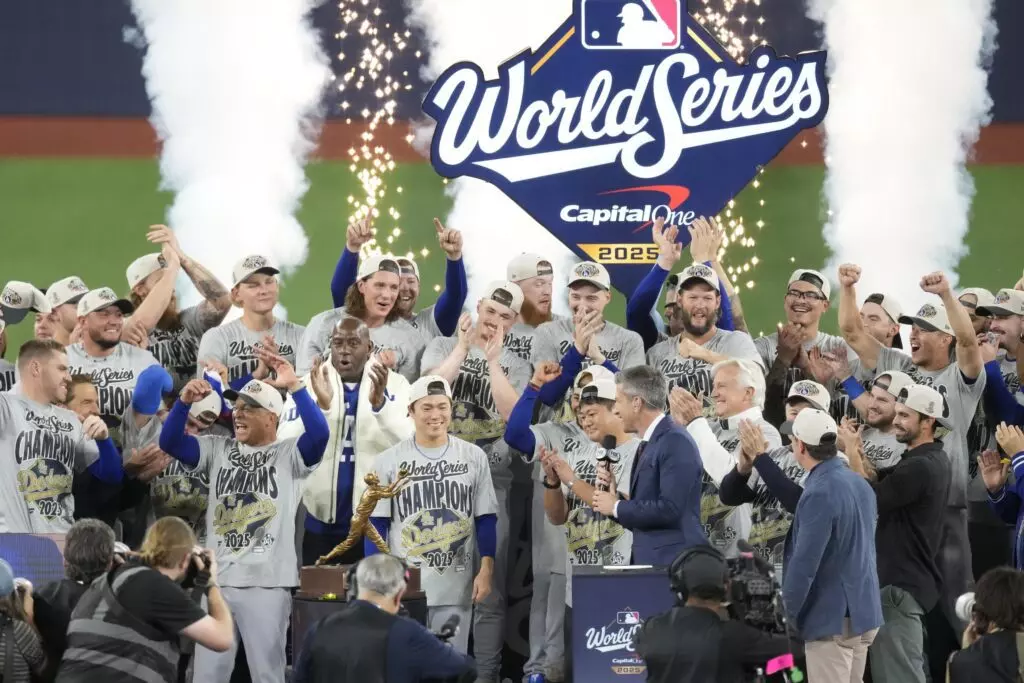
The Dodgers are chasing history. The first National League team to three-peat. The first team in baseball since the 1998–2000 Yankees. That’s the kind of legacy that changes how a clubhouse approaches April. Veteran players don’t coast when they’re 162 games away from making the Hall of Fame résumé case of a lifetime. Motivation is an underpriced asset in win total markets.
The under crowd points to 2025’s 93-win finish against a 105.5 total. But that season featured a rash of injuries, no true closer, and an outfield that was a genuine liability. All three problems have been directly addressed. Injury luck regresses to the mean. Díaz fixes the bullpen. Tucker fixes the outfield. The variables that drove the under last year are gone.
The Division and Schedule Say So Too
| NL West Team | Projected Win Total | Assessment |
|---|---|---|
| Los Angeles Dodgers | 103.5 | Heavy favorite |
| San Diego Padres | ~90.5 | Lost ground in the offseason |
| Arizona Diamondbacks | ~84.5 | Average at best |
| San Francisco Giants | ~80.5 | Rebuilding |
| Colorado Rockies | 54.5 | 19 free wins per year |
The Dodgers are -650 favorites to win the NL West. The Rockies’ win total is 54.5 — they will be punched around for 19 games every year. The Giants and Diamondbacks are average at best. San Diego has a legitimate core but lost ground in the offseason. The Dodgers will feast on their division in a way that pads win totals regardless of what the rotation is doing.
The Verdict
Every analyst citing the under is correct that this is a dangerous line. The Dodgers have finished under a triple-digit win total two years running. But they’re betting on load management to persist while ignoring that the team just addressed both of its structural weaknesses: closer depth and outfield quality. Add a motivated clubhouse chasing history, the deepest rotation in the game, and the weakest division in the NL, and 104 wins isn’t a ceiling. It’s a floor. Take the over.
Main Image: © Kevin Sousa-Imagn Images