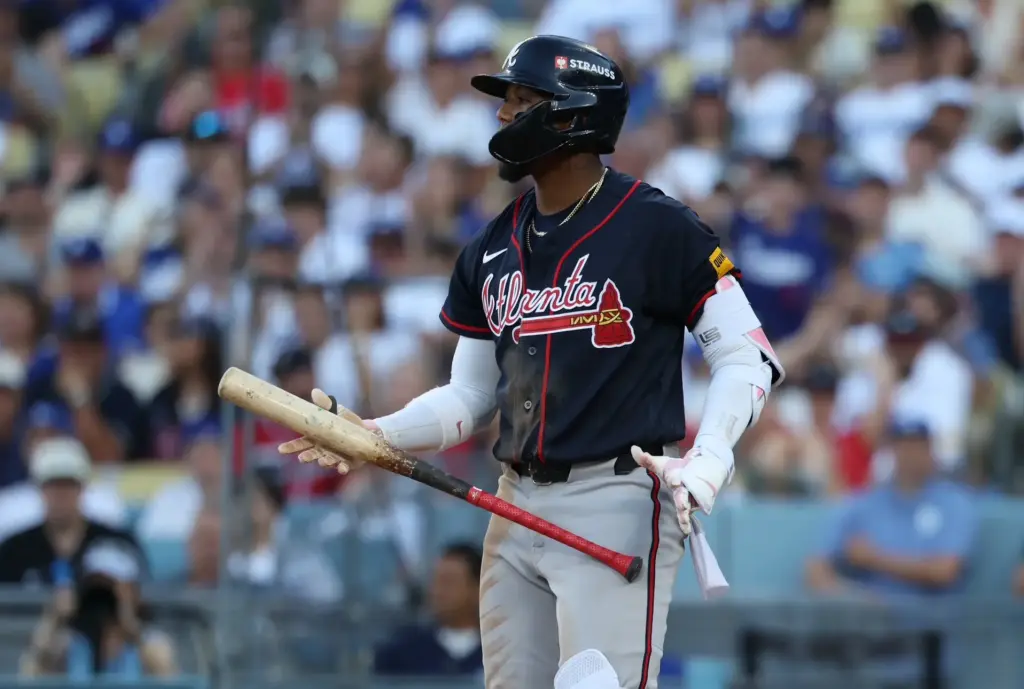
The Atlanta Braves are no strangers to adversity. Following two seasons defined by significant injury losses, the 2026 campaign began with a devastating blow: newly signed starting shortstop Ha-Seong Kim suffered a torn tendon in his finger, ruling him out for four to five months. The loss of a projected defensive anchor leaves Atlanta relying on an “emergency” solution, likely a mix of Mauricio Dubon and newly signed Jorge Mateo, for the first half of the season.
While this scenario feels like déjà vu for a team that saw its 2025 campaign derailed by similar issues, the 2026 Braves are uniquely positioned to survive this early-season storm. Through a blend of veteran utility depth and a high-octane core, Atlanta can keep its head above water until reinforcements arrive.
Can the Braves Survive the First Half with an Emergency Shortstop?
The Immediate Replacements: Dubón and Mateo
Following Kim’s injury, the Braves did not panic. They immediately pivoted to a strategy of depth, acquiring the veteran infielder Mateo, this after they had already acquired Dubón from Houston.
Dubón, in particular, is an intriguing option. While primarily considered a utility player, he was acquired to handle infield duties and has demonstrated capability in limited major leagues innings at shortstop. He is a reliable veteran who likely will not be overwhelmed by the pressure of the starting job.
Mateo, meanwhile, provides elite speed and respectable defensive ability. While his 2025 campaign with the Baltimore Orioles saw him struggle at the plate, his career experience as a shortstop provides a safety net that the 2025 Braves often lacked. In short, this isn’t a “rookie trial” scenario, it is a veteran platoon approach designed to keep the defense solid while awaiting a star’s return.
The “Aircraft Carrier” Factor
A key takeaway from recent Braves struggles is that the team does not need elite production at every position to win. While shortstops in 2025 brought the team essentially zero value (-3.4 bWAR), the 2026 roster is designed to be carried by its superstars.
The margin for error in Atlanta is high at the top. If Matt Olson, Austin Riley, and a healthy Ronald Acuna are performing at their MVP-caliber levels, the team can afford average, or even slightly below-average play from the shortstop position. The goal of the “emergency” shortstop is not to provide 20 home runs, but to make the routine plays and keep the defense stable while the offense drives the ship.
A More Resilient Roster
Unlike in 2025, when injuries decimated the lineup, the 2026 Braves appear better prepared for roster fluidity. The team is already looking at other options, like re-signing veteran infielder Luke Williams to bolster depth.
Furthermore, if the internal options fail to produce, the Braves have proven they will be active in pursuing external, cost-effective options, such as potentially looking into trading for infield depth if early results are disastrous.
Long-Term Outlook vs. Short-Term Survival
The goal for the first half of 2026 is strictly survival. With Kim projected to return around June, the emergency plan only needs to succeed for about 60-70 games. Given the Braves’ track record of winning, even after losing key players like Spencer Strider in previous years, this team is built to endure.
The Braves have a defense-first, high-speed, low-power combo at shortstop and their goal is to maintain a .500+ record to stay in the NL East race until Kim returns.
Fixating on the shortstop position is natural, but as 2026 begins, the success of the Braves will depend on their top-tier talent performing at their peak, rather than the “next man up” at shortstop. If the “aircraft carriers” are healthy, the Braves can navigate the crisis.
Main Image: Nathan Ray Seebeck-Imagn Images