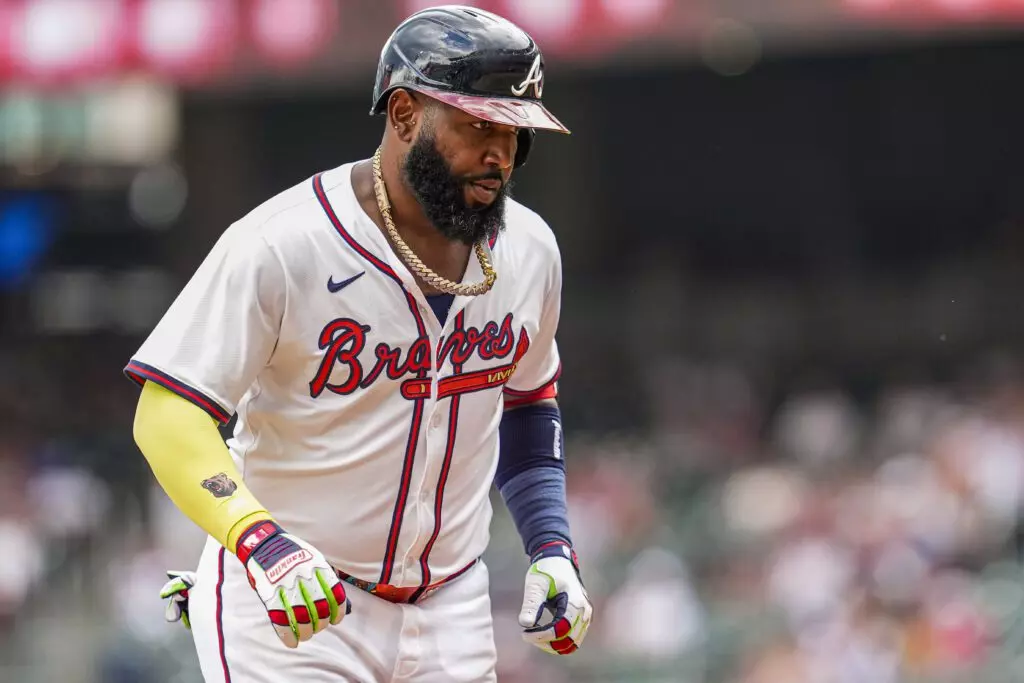
As the 2026 Major League Baseball offseason progresses, one of the most curious cases on the open market is veteran slugger Marcell Ozuna. Despite a resume that includes multiple 30-home run seasons and a recent fourth-place finish in the NL MVP voting, the “Big Bear” remains unsigned as spring training approaches.
His lack of a contract is not due to a single factor but a “perfect storm” of performance decline, specialized utility, and age-related red flags that have made front offices cautious.
Five Key Reasons Marcell Ozuna Remains Unsigned
1. The 2025 Performance Cliff and Injury Concerns
The primary driver behind Ozuna’s stagnant market is a troubling 2025 campaign that saw his production crater after a hot start. While he hit 40 and 39 home runs in the two preceding years, he managed just 21 home runs in 2025.
The underlying data is even more concerning. Analysts note a “stark contrast” in his performance after June 1, 2025, which coincided with a hip injury. Before June 1, Ozuna hit .284 compared to just .199 after June 1. Teams are wary that this “accelerating decline” isn’t just a slump but a sign that the 35-year-old’s body is no longer holding up to the rigors of a full season.
2. The “DH-Only” Limitation
In an era where roster flexibility is a premium, Ozuna is a pure designated hitter with “zero to negative value” in terms of baserunning and defense. His hard-hit rate dropped from the 96th percentile to the 56th, and his bat speed similarly fell, suggesting he may no longer have the “elite” power necessary to justify a roster spot that provides no defensive utility.
Many modern teams, including his former club, the Atlanta Braves, prefer to use the DH spot to rotate regular starters and keep them fresh. Committing a multi-year deal to a 35-year-old full-time DH limits a manager’s options, making Ozuna a tough sell for contenders who value versatility.
3. A Crowded Market for Power
Ozuna hit free agency at a time when the market was saturated with similar or more well-rounded power profiles. Teams looking for middle-of-the-order bats have had options like Pete Alonso and Kyle Schwarber, who offer either younger age profiles or more consistent recent production.
Furthermore, the Braves appear to have moved on, signaling a preference for a platoon approach with players like Jurickson Profar and Drake Baldwin. When a player’s own team, which knows his medicals and clubhouse presence best, chooses not to make a qualifying offer or prioritize a reunion, other teams naturally take notice.
4. Lingering Off-Field Perception
While Ozuna has been described as a “positive clubhouse presence” recently, his history of off-field issues, including domestic violence and DUI arrests in previous years, remains a factor. Some reports suggest that while these issues are in the past, they are frequently used as “negotiating ploys” by teams to drive down his asking price.
5. Financial Expectations vs. Reality
Despite the red flags, contract projections for Ozuna still hover around a two-year, $30 million deal. In a market where mid-tier teams like the Cleveland Guardians are often “unwilling to break the bank” for rentals, there is a clear disconnect between Ozuna’s perceived value and what clubs are willing to risk on an aging veteran with a hip history.
Where Will He Land?
Ozuna remains an “intriguing” free agent because he still has the talent to be one of the best hitters in baseball. He still possesses the raw power to change a game, making him a potential late-offseason bargain for teams like the San Diego Padres, San Francisco Giants, or Arizona Diamondbacks looking for a low-risk, high-reward “rental” on a one-year deal. Until he lowers his asking price or a team suffers a spring training injury, the “Big Bear” may remain in hibernation.
Main Image: Dale Zanine-Imagn Images